
9. Sick Days
For your tamaiti / child, rangatahi / young person with diabetes
Understanding illness and diabetes
Tamariki (children) and rangatahi (young people) with diabetes do not usually get sick more often than others. However, when they are unwell, diabetes can be harder to manage.
When your tamaiti (child) is sick, the body releases stress hormones. These hormones can affect blood glucose levels:
• Illness with fever or infection often causes high glucose levels
• Gastro illness (vomiting and diarrhoea) can cause low glucose levels
• Vomiting may also be a sign that there is not enough insulin in the bodyBecause of this, your tamaiti (child) needs closer monitoring and ongoing insulin when sick.
General principles
If your tamaiti / child is unwell:
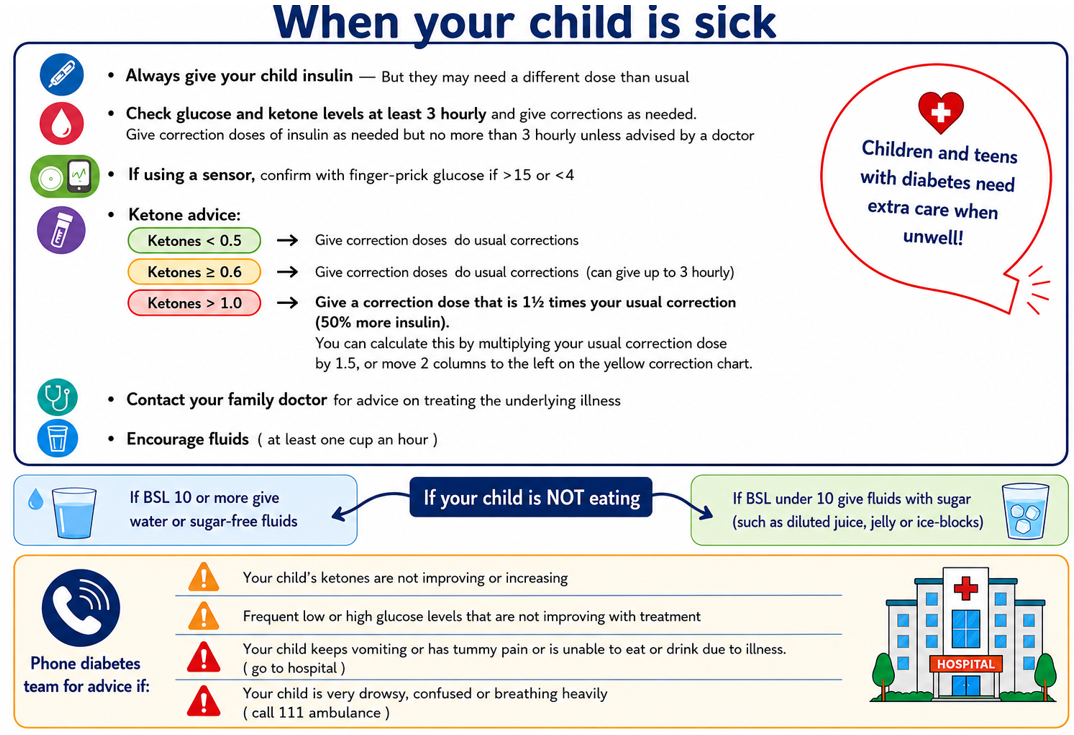
Always give insulin – never stop insulin completely
Contact your diabetes team for advice about dose changes
Take your tamaiti (child) to your GP to treat the illness
Check blood glucose levels every 2 hours
• Use finger prick testing – CGMS sensor may not be accurate if your child is dehydrated.Check blood ketones every 2 hours
Encourage your tamaiti to drink plenty of fluids
Managing symptoms
Treat pain or fever with Paracetamol or Ibuprofen
Even if your rangatahi (young person/adolescent) usually manages their diabetes independently, they will need extra support from their whānau (family) when unwell
Sick Day Insulin Adjustments – Injections
Ongoing high levels (above 10 mmol/L, including overnight)
If repeated corrections are not enough:
• Increase the long-acting insulin (Lantus) dose by 20%
How to calculate 20%
Multiply usual dose × 0.20
Example:
Usual Lantus = 20 units
20 × 0.20 = 4 units
New dose = 24 units
Return to the usual Lantus dose once your tamaiti (child) is well again.
Sick day Insulin adjustments on Insulin Pump Therapy
General approach
Follow all the general sick day advice above (monitoring, fluids, ketones, etc.)
Sickness on a pump
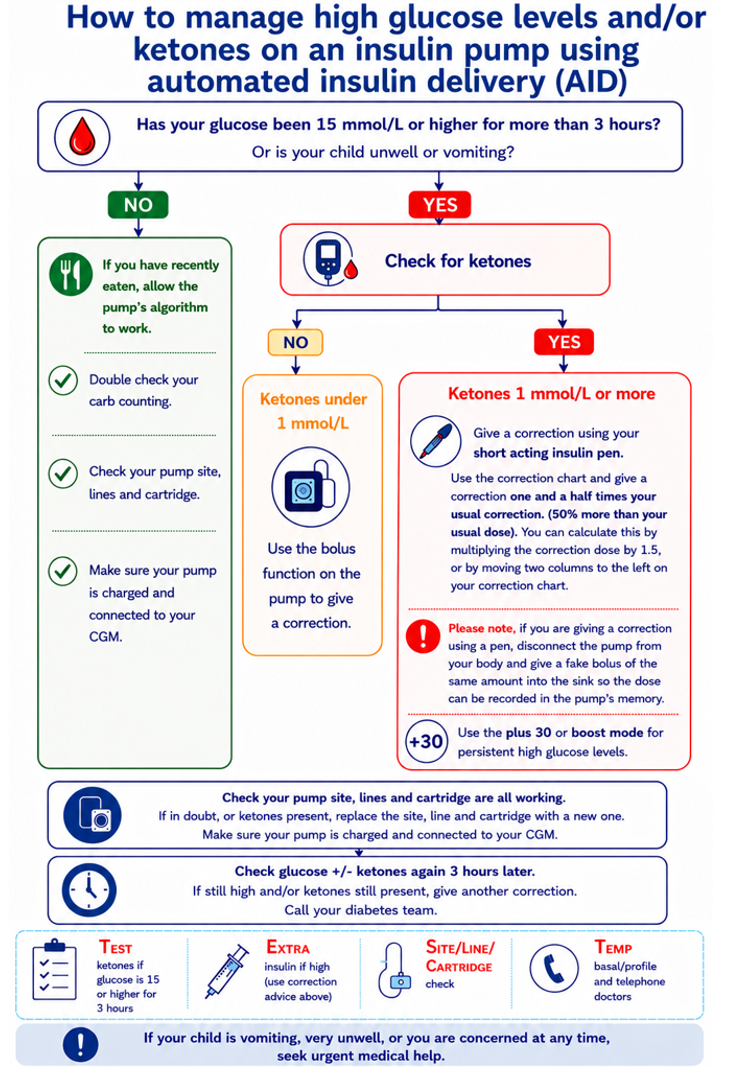
Being unwell usually makes you have high glucose. If your glucose has been higher than normal for more than 3 hrs then consider:
Use a plus 30% or 50% profile (or “boost” for YpsoPump).
Check your glucose before meals and snacks as usual or at your usual mealtimes if you are not eating. You may still need a correction even if you are not eating.
Check for ketones if your glucose is >15 mmol/L.
If ketones >1.0 and not resolving, follow the protocol for high glucose levels
If you are vomiting, you are more likely to have low glucose.
Check for ketones, even if glucose is normal, as you can develop ketones from starvation. If Ketones are >1, call the medical team or visit CED.
If glucose is <10mmol/L and not eating, encourage small amounts of sugary drinks e.g., diluted juice
Consider using a minus 30% or 50% profile (or “ease off” for YpsoPump) if having many lows.
When to call for help
Contact your diabetes team if:
Ketones are ≥1.0 mmol/L and not improving despite the plan above
Blood glucose remains:
• below 4 mmol/L, or
• above 10 mmol/L despite treatmentYour tamaiti (child) has ongoing vomiting or tummy pain
You are worried or unsure how to manage things or change insulin doses yourself
Your tamaiti (child) is very drowsy, confused, or breathing heavily (call 111 for ambulance)
Information to have ready
When you call, be ready to tell the team:
Age of your tamaiti / child
Symptoms (e.g., fever, vomiting)
Blood glucose and ketone levels
Whether your tamaiti (child) is eating or drinking
Usual insulin doses
Any medications given
Ketones explained
There is not enough insulin (missed insulin or pump site failure)
Your tamaiti (child) is unwell
Your tamaiti (child)is not eating – called starvation ketones
Ketones can occur:
During illness
When glucose levels are high
Even when glucose levels are normal or low (especially with vomiting)
If not treated, ketones can build up and make your tamaiti (child) very unwell.
Ketoacidosis (DKA) – Serious emergency
High ketones can cause the blood to become acidic. This is called diabetic ketoacidosis (DKA).
Symptoms include:
Nausea and vomiting
Tummy pain
Heavy or fast breathing
Fruity-smelling breath (like nail polish remover)
Confusion or drowsiness
Unconsciousness
If your tamaiti (child) has these symptoms, go immediately to: Starship Children's Hospital Emergency Department or your nearest Emergency Department.
When to test ketones
Every 2 hours during illness using CareSens Dual meter
If your tamaiti (child) is well but glucose is 15 mmol/L or higher twice in a row
Click the following link to watch how to test blood glucose and blood ketones.
Mini-dose glucagon
Mini-dose glucagon may be advised by your doctor when:
Blood glucose remains below 4 mmol/L despite treatment
Your tamaiti (child) has gastro illness
Your tamaiti (child) cannot or will not eat
This involves giving a small dose using an Insulin syringe (not the syringe that comes with the kit)
If you want to learn more about use of mini dose glucagon: Mini-dose glucagon
Only use this if directed by a doctor. Some tamariki (children/young people) may need hospital admission if glucose cannot be maintained.
Sick Day Kit (for your whānau / family)
Prepare a kit at home and check every 6 months:
Diabetes team contact details
Insulin pens and insulin.
Spare correction chart.
Pump supplies with details of correct correction factor documented (if used)
Blood glucose meter and strips
Blood ketone meter and strips
Fluids (sweet and sugar-free options)
Easy foods (soups, ice blocks)
Glucagon kit and insulin syringes ( for mini-dose gluagon)
Pain relief (Paracetamol or Ibuprofen)
Thermometer
Optional: medication for nausea or diarrhoea when travelling
Surgery and procedures
If your tamaiti (child) needs surgery or is fasting:
Insulin must still be given
The diabetes team must be involved in planning as doses will need to be changed
Morning procedures are preferred
Ideally performed at hospital experienced in dealing with tamaiti (child) with diabetes such as Starship Child Health
Other medications
Some medications (especially steroids) can raise blood glucose levels.
If your GP or hospital prescribes medication:
Ask if it will affect glucose levels
Contact your diabetes team for advice on insulin adjustments
Let's go over the main points. Think you've got it sorted now? Read our one page summary.
Think you've got it sorted now?
If you have read through the information above and watched the videos, and you feel confident that you understand this topic, print off and fill in the evaluation form below (you might need to ask someone to print this off for you) and return to the nurse on your ward. If you have any questions, note them down on this form and your diabetes nurse specialist will discuss them with you
Sick Days Advice for Newly Diagnosed Families: Evaluation
After reading this teaching module and watching the videos:
| Yes | No | |
|---|---|---|
| I know when to call the doctor when my child is sick | ||
| I know how often to test my child’s blood glucose levels when my child is sick | ||
I know how and when to test my child’s blood glucose and ketone levels when my child is sick | ||
| Know what the signs and symptoms of Diabetic Ketoacidosis are |